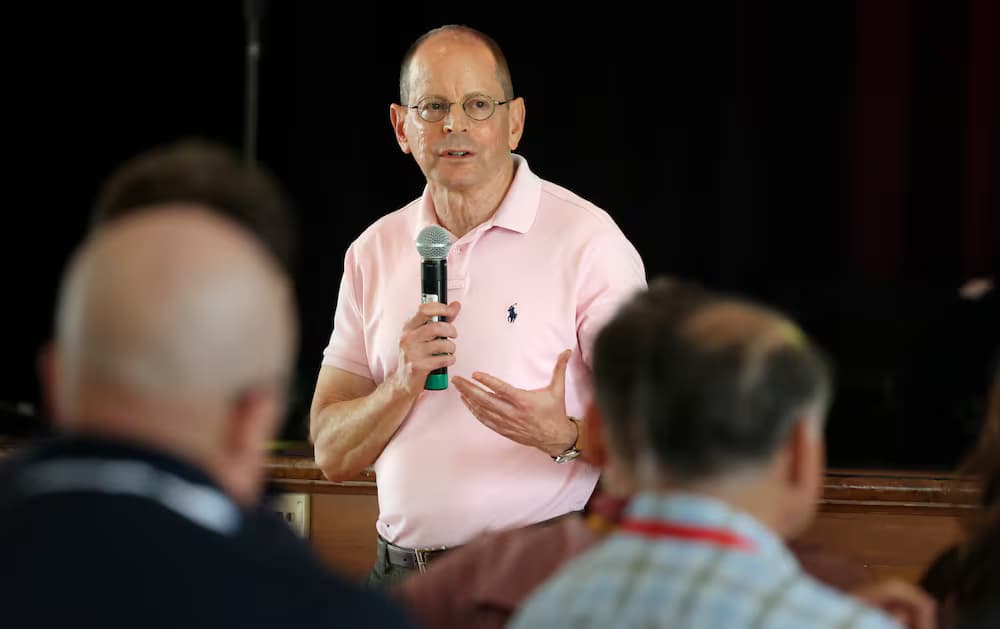
Last week, successful author, journalist, and atheist academic Jonathan Rauch visited BYU campus to speak at a forum hosted by the Wheatley Institute. The stately event was well attended, with BYU President Shane Reese and a few general authorities, including Elder Quentin L. Cook and Elder D. Todd Christofferson, in the audience. Such an impressive guestlist may be due to the fact that Jonathan Rauch has a message that resonates (mostly) harmoniously with many of the recent teachings of Church leadership.
At the Tuesday campus devotional just before Rauch’s visit, Elder Stevenson renewed President Nelson’s call for Church members to become peacemakers; Rauch would echo many of those sentiments in his own speech. It’s a message that I, as a political conservative and faithful member of the Church, very much agree with. I left Rauch’s lecture feeling mostly pleased with what I’d heard. But, as I’ll explain, Rauch used some arguments that I found questionable, even if, in the end, his main points were extremely sound.
Given Rauch’s background as an atheist Jewish academic and openly gay man, his praise of the Church of Jesus Christ of Latter-day Saints may seem unexpected. However, his pragmatic approach to politics and religion has made him an outspoken supporter of not just the Church but of classical Christianity as a whole. One of the core tenets of his philosophy is that, as he puts it, “Christianity is still a load-bearing wall” of the American system, despite the attempts of secular liberals to prove otherwise.
Rauch framed his 50-minute lecture around his own views of Christianity and how his long-held skepticism evolved into appreciation. He recounted how he once wrote an op-ed for the Atlantic in the early 2000s where he celebrated the rise of secularism in America, even calling it a “major civilizational advance.” He now says it is the “dumbest thing I ever wrote” and professes firmly that the decline of Christianity is putting America’s continued existence in jeopardy.
Rauch pointed out the data-backed correlation between the decline in religiosity since the 2000s and the increase in political polarization over the same period. He noted that the rise of secularism is statistically linked to increasing loneliness and decreasing social cohesion. He often punctuated these data-driven findings with quotes from the Founding Fathers, arguing that the Constitution was designed only for moral and religious people, not a secular people.
As Rauch put forth his claims and evidence, the message resonated deeply with me, and I found myself in complete agreement for the majority of the lecture. My main moment of dissatisfaction with Rauch was when he was identifying the results of widespread secularization. First, progressive wokeism, which has emerged as a pseudo-religious substitute for Christianity, and second, politicized right-wing evangelicalism. He briefly and pointedly rebuked the first but then spent much more time condemning the second, going after “white evangelicals” with a larger amount of fervor than I think they deserved in the context of his remarks.
On a personal note, I generally find myself being among the last in a room to come to the defense of evangelicals. There are many valid criticisms to be made of their religious tendencies and culture, particularly their treatment of our faith. However, it felt that their absence became an excuse to pile negativity on them, and Rauch seemed to attribute an outsized amount of the blame for the state of our modern politics.
In my opinion, Rauch made a good argument that evangelicals are extremely politicized and overwhelmingly in favor of the conservative right. He reasoned that a wave of secularization has impacted churches, leading to increased politicization. But to argue that saying you’re evangelical just means “I am a conservative Republican” seems, to me, a hazardous over-simplification of a very complex religious demographic.
This sort of generalization occurred a few different times. At one point, Rauch showed a clip of Donald Trump Jr. speaking to a crowd of Christians at a rally and saying, “Turning the other cheek has gotten us nothing.” Rauch then excoriated him for blatantly using politics as a rationale to abandon Christ-taught principles in favor of scoring political points.
The most honest way to dissect this statement from Donald Trump Jr. would be to steel-man his argument, which means to find the strongest reasonable defense of why he said it, what meaning he intended, and the full context in which it was spoken. Steel-manning follows the principle that if an argument can’t win against the best possible version of its opposition, it’s not very convincing.
The case could theoretically be made that Don Jr. intended to convey the idea that Christians need to start showing up to the voting booth to protect religious freedom. Perhaps when he said “has gotten us nothing,” he meant it in a strictly political sense, meaning Christians have allowed their values to be disregarded by government institutions for too long, and it’s time to start voting for candidates that defend those values.
Instead of engaging in nuance to strengthen his case, Rauch damaged his own credibility by showing only a few brief clips and extracting the worst possible interpretation. This weakened his main claim that evangelicals have overly politicized Christianity – a claim I believe may have merit but should have been articulated without indulging in condescension. There is much to be debated on this topic, but I feel it important to say that if we continue to berate evangelicals or talk to them from atop our high horses, I doubt progress will ever be made in solving the issues that Jonathan Rauch wishes to solve. This is my biggest critique of what, to me, was overall a very persuasive and well-reasoned lecture.
Overall, Rauch made many excellent points. He praised the Church of Jesus Christ of Latter-day Saints for being champions of civil discourse. He made the bold – and extremely invigorating, considering the source – claim that our church is the only one that believes trying to be like Jesus Christ is critically important and has a fully rational, well-articulated doctrinal basis for that belief. Because of this, Rauch said multiple times that we deserve an audience with the whole country to share our perspective and that society would be so much better off for it.
He used the example of the Utah Compromise of 2015 as an extremely momentous and encouraging development, which gave him hope that civility can lead to healing the divide between the religious and secular in America. I know many religious conservatives grow anxious and defensive whenever words like “compromise” or “civility” are thrown at them, and many may feel that Jonathan Rauch is advocating for a form of Christianity that is soft, easily pushed over, and trampled upon by secular institutions. Indeed, I know many members of the Church of Jesus Christ of Latter-day Saints who have a difficult time understanding how they can advocate strongly for their values while also following the counsel to be peacemakers, and that makes others like myself concerned that some of those members may be willing to abandon core doctrines of the gospel in order to avoid contention. It’s an internal conflict that will be crucial for us as members of the Church to resolve soon, as attacks on our faith are certain to only grow in the coming decades, and knowing how to advocate firmly for ourselves will become ever more important.
But speaking as one who is very sensitive to and easily annoyed by people who advocate for this “soft and squishy” Christianity, I can say that I left Jonathan Rauch’s lecture feeling proud to be a member of the Church and resolved to learn more about how I could be a more Christlike defender of the faith. As annoyed as I was about Rauch’s condescension towards evangelicals, I propose that some of his criticisms are valid, and we should be careful not to become so militantly politicized as some Christians today are. And while I wish he had spoken more about how Christians can be strong advocates as well as civil citizens, nothing he said was an argument for weakness.
In my opinion, Jesus Christ was (and is) the strongest, most unrelenting, most unyielding defender of truth and principle who has ever lived. He did not shy away from confrontation, nor did he always avoid a heated exchange. But he was also the embodiment of love, forgiveness, meekness, humility, and compassion. Somehow, we will have to find a way to emulate all of those things if we truly desire to be peacemakers. This, to me, was the root of Jonathan Rauch’s message. It was a plea from an outsider for Christians to communicate and advocate for our values with Christlike maturity, as did our Lord.
Written by: Kimball Call
Contributor at the Cougar Chronicle
The Cougar Chronicle is an independent student-run newspaper and is not affiliated with Brigham Young University or The Church of Jesus Christ of Latter-day Saints
Cover photo: https://www.deseret.com/2023/10/8/23906311/jonathan-rauch-christianity-religion-democracy/