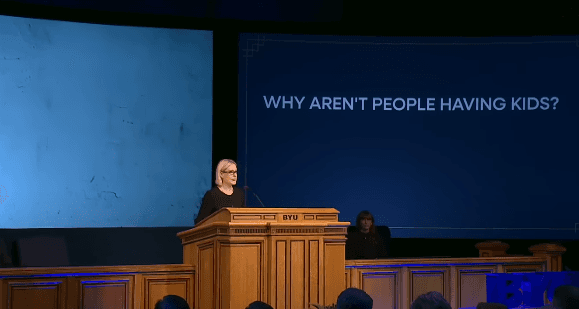
When Elder Clark G. Gilbert introduced Catherine Pakaluk, an economist and social philosopher at the Catholic University of America, as the BYU forum speaker on October 28th, not many people knew what to expect from the message she would share. Within moments, she established herself as a fierce defender of the family and an advocate for the value of children.
She started by discussing the decreasing birth rate in the US and worldwide. She shared that if birth rates remain this low, the world’s total population will likely peak within the next 30 years. There are negative economic repercussions for a declining birth rate, and there are also negative social repercussions. When people have fewer children, sibling and family relationships are less accessible, and overall socialization skills are inhibited, leading to more loneliness and other concerning mental health issues.
Dr. Pakaluk asserted that marriage and childbearing are not something that “just happens,” but that they are part of the spiritual domain for us as reasoning beings. This means that the birth rate is declining because the cultural need and desire for children is decreasing, which is why less people are deciding to participate in family life. She compared the decreasing birth rate with the decrease of horses found in society. The invention of the car led to the fall of the horse as a commonly owned animal, because the need decreased. In the same way, the need for children and marriage to support of the family economically and socially has practically disappeared. Now, because the need and even the desire for children has decreased, and because society hardly makes accommodations for children and families, fewer people are deciding to have kids.
As she began to discuss solutions to the declining birth rate, Dr. Pakaluk pointed out that many proposed solutions, such as tax credits for each child a family has, have not worked and will not work because they did not address the root issue: people do not want children. She said that the problem is the same across all economic levels, which means that even those who are not under financial stress are not having many children simply because they do not see a reason to do it. Instead, they use their resources to prevent having children.
She then shared some quotes from mothers that she interviewed as part of her research, where they talked about what it is like to be a mother in this society. They shared since they have become mothers, they have made many sacrifices and the way that they spend their time has changed drastically, but they also expressed that they have found immense value and joy in motherhood. One of the women she quoted shared that all other accomplishments are “secondary to what you contribute to the world [as a mother], which is the future of humanity.”
To conclude her message, Dr. Pakaluk discussed the divine calling of parenthood, emphasizing that each child born is made in the image of God, and it is a privilege to bring them into the world and raise them. She proposed that “the fire of faith is the anti-venom to this economic wound that children now bear,” and that religious community, and therefore religious freedom, are essential to combat the declining birth rate and to make families the sacred sanctuary that they are supposed to be. It is the responsibility of the churches, not the government, to support families and provide education, and when that happens, the birth rate will increase and children will be cherished, as is seen in religious communities throughout the nation.
Cover Photo Source: