
Earlier this year, I publicly criticized Braver Angels–a nationwide political depolarization group–for their role in Utah Valley University’s poor response to Charlie Kirk’s assassination. Several members of the organization reached out to me as my post went semi-viral, and I was eventually invited to meet with their CEO, Maury Giles, in person.
After we exchanged perspectives on how UVU handled Charlie Kirk’s assassination, the conversation turned towards the broader depolarization movement. Both he and I identify as “conservative,” and it surprised me how much we agreed on. Here we were, the outspoken editor of a fiery conservative newspaper, and the CEO of a reputable depolarization organization, sharing many of the same perspectives.
It was in how we were inclined to act on our perspectives that separated us most. Maury, and many others like him, depart from the main conservative coalition by valuing depolarization above other considerations. Whereas myself and many others find such conscientious objection to the culture war to be useless at best, and treasonous at worst.
Apparently, this attitude from conservatives is a grave concern for Braver Angels, who consistently have left-leaning “blues” outpacing right-leaning “reds” in engagement and participation, despite their leadership being an intentionally even split. When Maury invited me to the Braver Angels national convention in Philadelphia, I accepted.
At the convention, my goal was to better understand why many conservatives like myself don’t resonate with–and sometimes feel threatened by–depolarization rhetoric. In exploring this topic, I also wrestled with the concept of peacemaking–a word that’s now loaded with meaning, particularly for members of The Church of Jesus Christ of Latter-day Saints.
After years of being exhorted to be peacemakers by our prophetic leadership, many of us–including myself–still have unresolved questions about how it’s supposed to be applied. Does peacemaking mean we can’t engage fully in the grand contest of politics? Does it mean sparing people’s feelings is more important than defending truth? Does it mean we shouldn’t want our side to win?
This essay represents my best conclusions. I could be wrong, but for the moment I think I’m right. I hope I’ll receive constructive feedback from all sides.
From my observations, there appear to be two fundamental disconnects at the heart of the divide between the bridgebuilding movement and many conservatives. First, the nature of the political and cultural divide in America; and second, what it means to be a peacemaker. I will start by addressing the first.
The Dark Forest
In his Three-Body Problem trilogy, Chinese sci-fi author Liu Cixin proposed a disturbing solution to the Fermi Paradox (the question of why space seems so devoid of other intelligent life) which he called “The Dark Forest Theory.” Because I hate spoilers, and because everyone should definitely go read it, I won’t explain it fully in context. But I am going to co-opt parts of it to use as an evocative framing device to help us get into the mind of the conservative movement.
Imagine a vast, dark forest in which skilled and solitary hunters silently stalk their prey. In this forest, communication is difficult and cooperation is not an option, so each takes every precaution to conceal themselves from each other.
When one hunter inevitably discovers another, two invisible forces immediately act upon him to compel him to attack. The first is the hunter’s knowledge that the other has traps, supplies, and territory that would greatly improve his own prospects for survival and prosperity in this dangerous environment.
The second force is the frightening knowledge that the first force is acting upon his peers just as powerfully as it is on himself.
The calculation happens quickly. The hunter can either kill his opponent, thus eliminating an existential threat to himself while also greatly improving his own condition; or he can let the other hunter live, leaving the threat alive and risking his own future survival on the slim hope that one day, when the other hunter discovers him, they will make the same selfless (and unnatural) choice.
No wise hunter would take that risk, so all encounters end with at least one dead hunter.
Death Ground
Let’s apply this thought experiment to politics, with “hunters” being coalitions of people with shared value systems like nations, political parties, or smaller political factions. Instead of arrows, these groups use elections, policy, and popular opinion as their instruments of force.
When rules for competing peacefully are established and followed, human coalitions can generally avoid the existential confrontations of The Dark Forest. This changes when another ingredient gets added–something Sun Tzu calls “death ground.” This is when at least one side of a conflict feels backed into a corner with no retreat and will perish if quick and decisive action isn’t taken.
This is how large elements of the conservative coalition in America have felt for decades. Years of political and cultural defeats slowly added up. They watched as their value systems (characterized generally by faith, family, free markets, and patriotism) were ousted and increasingly vilified by academia, the press, and Hollywood. They have fresh memories of being banned and cancelled on social media, of seeing conservative thought-leaders removed from universities, and of being demonized in their own schools, neighborhoods, and workplaces.
By the mid-2010s, conservatives began to say to themselves, “If we don’t defend our value systems, they won’t exist anymore.” They were put on death ground in an ideological sense. They didn’t literally fear for their lives; rather, they feared for their way of life, and the last option they saw for ideological survival was to retaliate in strength. Donald Trump is a product of this retaliation.
Years of lawfare, conspiracy theories, impeachment efforts, and attempted assassinations of conservative politicians added to the perception that conservative ideology was on death ground. The premeditated assassination of Charlie Kirk, and the reaction by many progressives online, was another reaffirmation.
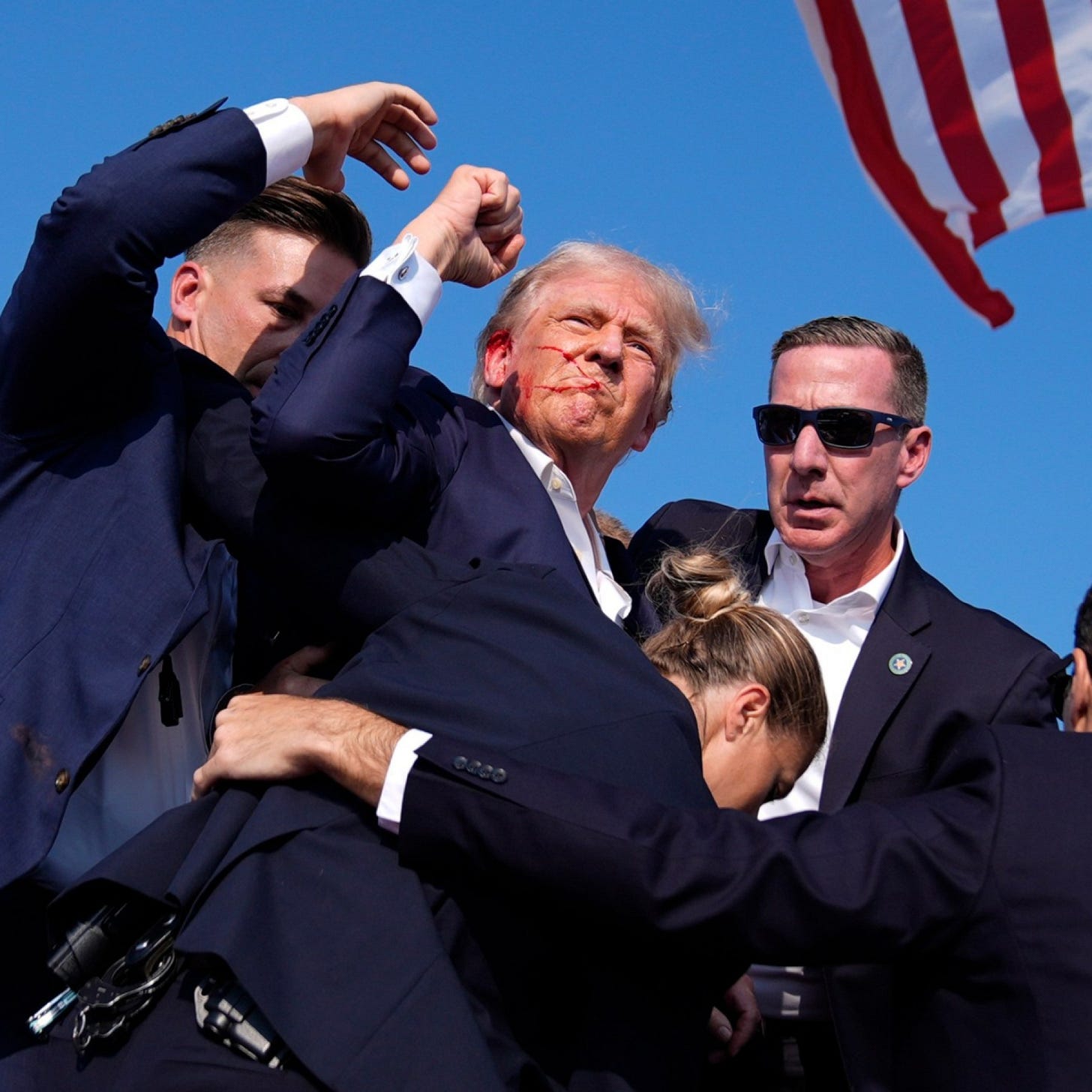
For their part, progressives saw the sudden resentment-fueled surge of conservatism–including Donald Trump’s belligerent and threatening behavior–as a threat to the institutional gains they had made over the years. Add to that the MAGA movement’s willingness to take unprecedented action, and it’s understandable why progressives perceive themselves to be on ideological death ground as well.
And with death ground established, America entered The Dark Forest.
Note: The role of social media and the Great Rewiring must also be acknowledged. In my opinion, it is very likely that the mass adoption of the internet and social media accelerated the process of entering the Dark Forest; like lowering the boiling point of water by increasing atmospheric pressure. Reducing this “catalytic” effect of technology and related factors is crucial for a long-term restoration of a less polarized society.
Why Blues Outnumber Reds
This is the first fundamental disconnect between conservatives and those in the bridge-building movement. They see themselves as locked in an ideologically existential confrontation with the progressive left who, if given the chance, would like to remove their values from America completely.
Given this perception, conservatives are understandably unimpressed when organizations like Braver Angels speak idealistically of a world where we can peacefully coexist despite our incompatible value systems. To many, sometimes including myself, the rhetoric from these groups is off-putting because it lacks understanding.
It’s not that conservatives are opposed to civil discourse, treating people with dignity, or the virtues of peacemaking; it’s that their situation feels more dire than Braver Angels treats it.
And because trust in our shared institutions is so low, some even doubt the integrity and authenticity of some depolarization groups, especially those that frequently cast blame on the conservative right for the current situation (which they view as little more than victim blaming). There’s precedent for this fear too. I recently wrote about how Sharon McMahon–who brands herself as nonpartisan and frequently uses depolarization rhetoric–misleads her followers and spreads left-wing talking points under the guise of being “unbiased” and “principled.”
So rather than spend time at things like Braver Angels gatherings, conservatives engage in the activities that might contribute to the next decisive victory–the only way, in their minds, to truly protect their value systems.
Note: When I shared this perspective with individuals within Braver Angels, they reassured me that they have no intention of trying to get conservatives to abandon their values–in fact, they want conservatives to feel empowered to defend them. I respect and admire that mission, but so long as Braver Angels positions themselves as a third party in The Dark Forest, with their own agenda and vision for the country, there will always be a trust gap between them and most conservatives.
Dark Forest Strikes
So if they don’t want to find a way for value systems to coexist, what do conservatives want? What is their plan to escape The Dark Forest?
Well, the usual way out is for one side to decisively win. And, in The Dark Forest, it’s not a matter of which side is strongest, it’s a matter of which side is willing to take the most decisive action or go to the greatest lengths. This is a Dark Forest Strike–a move for dominance made with the intent to neutralize an opponent, characterized by immense force and indomitable willpower.
In the American colonies circa 1776, the opposing value systems of the American colonists and the British Crown had long since placed each other on death ground–in some ways more literal–and entered the Dark Forest. The British were objectively stronger, but the colonists would soon prove that their political will was much less exhaustible.
The signing of the Declaration of Independence was the initiation of the first Dark Forest Strike in American history. While at the Braver Angels Convention in Philadelphia, I visited Independence Hall, the room where the American hunter, having spotted his adversary through the trees, made its calculations, knocked its bow, and fatefully chose to let it fly.
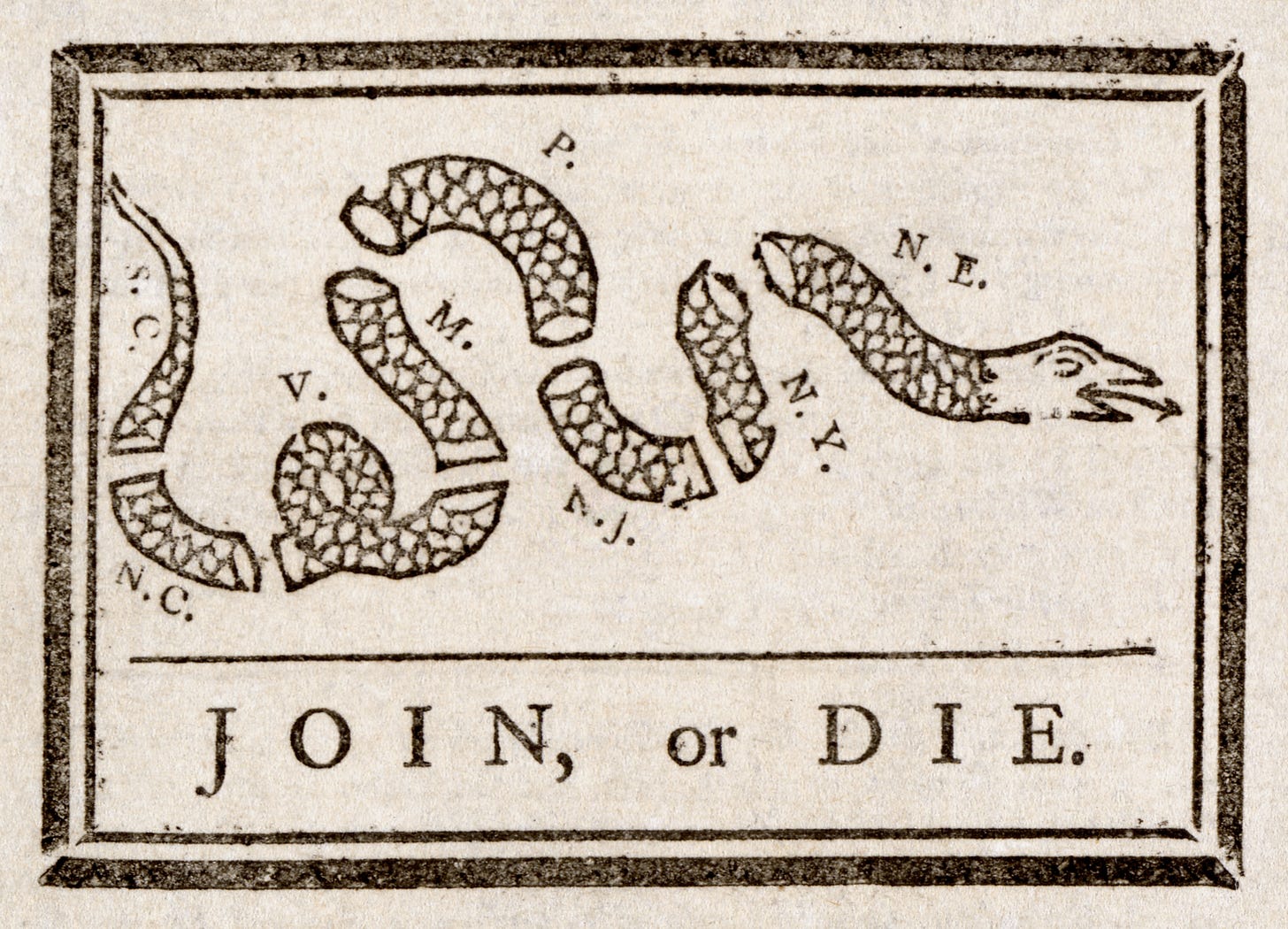
As Benjamin Franklin’s repurposed propaganda put it, “Join, Or Die.”
The Story of America
The Founders’ gamble eventually led to the indisputable military victory at Yorktown and the political victory of the Treaty of Paris. With a clear winner and loser determined, the way toward peace was open. I argue that this pattern has been followed throughout American history whenever two opposing value systems placed each other on ideological death ground.
There is, of course, the slavery crisis, in which northern abolitionists and slave-holding southerners could not reconcile two diametrically opposed models for human flourishing, despite decades of effort to compromise and engage in civil discourse. Ultimately, each side opted to make the decisive strike at the other, plunging the country into Civil War.
Abraham Lincoln successfully navigated the Union through this Dark Forest. Through his expert political maneuvering and willingness to go to extreme lengths, he eventually won successful military and political victories. The key Dark Forest Strikes he initiated against slavery include the Emancipation Proclamation, the 13th Amendment, and the choice to only readmit confederate states once slavery was legally abolished.
A century later, the Civil Rights Movement brought America once again into the Dark Forest, and only after the passage of the Civil Rights Act, a convincing political victory, could the crisis begin to end.
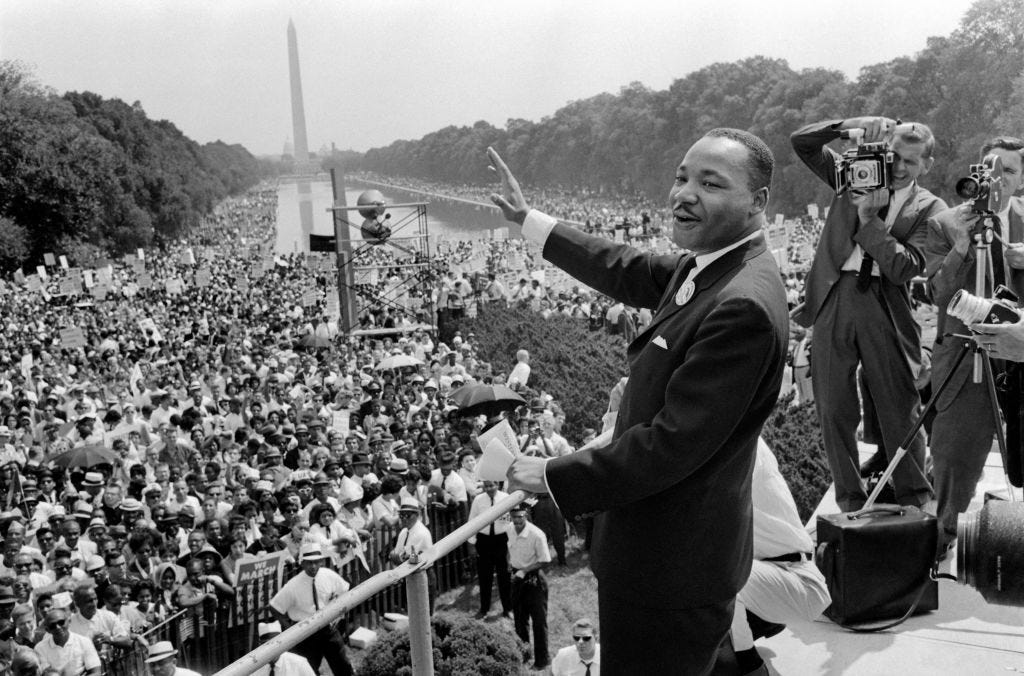
In each of these cases, the virtues espoused by Braver Angels and similar depolarization groups were present, but they were not what ultimately brought peace. Peace only came when one side had won, and the other lost, through a decisive victory. Sometimes that victory relied on moral character, civil discourse, and treating humans with respect. Other times it required much more.
At the Braver Angels convention, I asked many individuals a question: “What should we do if two people with completely opposite value systems apply all of the civil discourse and dignity standards of Braver Angels and still can’t find enough common ground on which to peacefully coexist?”
Most people responded by rejecting the premise. One person even did it conscientiously. “I have faith that we are not at the point where we can’t peacefully coexist.”
This illustrates the disconnect. Depolarization groups have a level of faith in our situation that not even the Founding Fathers had in theirs. And it makes sense to me why conservatives–who still carry the collective memory of being gradually pushed, then forcefully shunted from their own culture and institutions–are far less likely to have that faith.
Why We Can’t Always Coexist
Slavery vs. abolition, Jim Crow vs. civil rights, British imperialism vs. democracy. Each of these were value systems incompatible enough to drive each other to death ground.
But are we there today?
In some ways, it seems to me like we are. In our case, our irreconcilable value systems include the conflicts between life and abortion; radical socialism and free-market capitalism; transgenderism and biological gender; and critical race theory-based diversity, equity, and inclusion (DEI) practices and colorblind meritocracy.
As with the issue of slavery, each side of these various issues will work toward decisive victories until, inevitably, one side is pushed out for good. This is why seeking coexistence as the ultimate end is nonsensical. Even if some compromise is successful for a time, it delays the inevitable so long as our value systems remain at such odds.
It’s hard to picture a scenario where we find an enduring middle ground between these divides. Take race as an example. Conservatives want a colorblind meritocracy (judging people by the content of their character rather than the color of their skin), whereas much of the current DEI apparatus operates on the opposite premise: that racial disparities in outcomes are themselves proof of ongoing systemic racism, and that closing them requires corrective racial discrimination.
These are incompatible models with fundamentally opposed starting assumptions. Eventually, if we are to share a country and its various institutions, we will need to settle on one way of seeing race. On this front, as on many culture war fronts, lasting compromise is unrealistic. For lasting peace, one side needs to decisively win.
What It Means to Win
I want to strongly clarify that I am not saying that all means justify the end. I’m not advocating for political violence, subverting the Constitution, or any other behavior that is not Christlike or dignified. I am also not saying a civil war is needed to solve our problems.
In our Dark Forest situation, there are three things needed for a “decisive win.” These are first, political victories; second, cultural victories; and third, an accumulation of each over time.
A political victory is when one side maneuvers the levers of power in such a way that renders the opposing value system politically inert. For instance, the Civil Rights Act of 1964 achieved many of the aims of civil rights leaders of the time, while dealing a mortal blow to the political aims of Jim Crow racists.
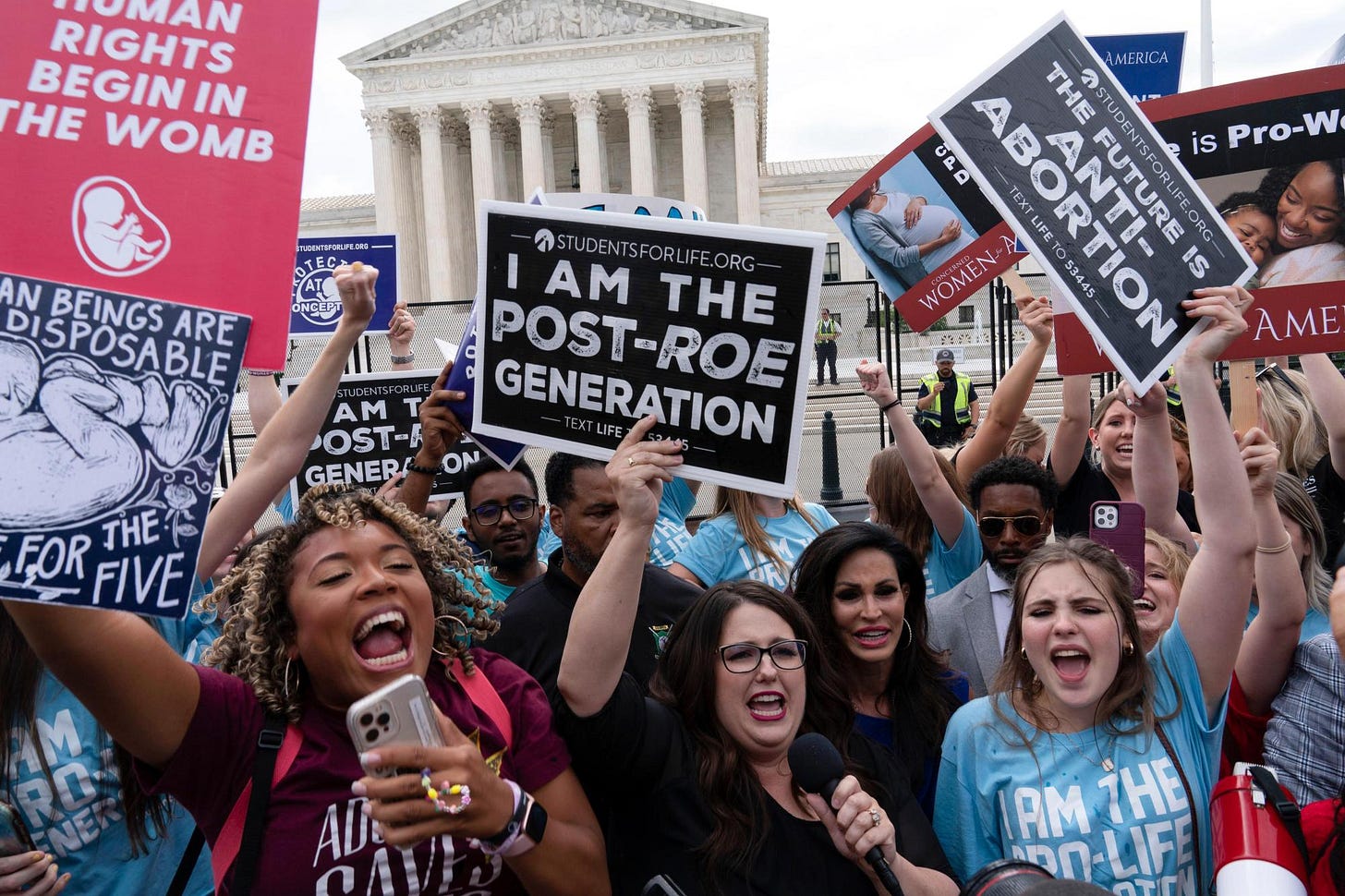
Today, both sides aim for political victories of similar magnitude. When Roe V. Wade was decided in 1973, it dealt a crippling political blow to the pro-life movement for almost 50 years. Its overturning in 2022 was a political victory in the other direction, and opened the door for further conservative victories in state-level legislation.
Cultural victories are different, and arguably even more important than the political because it’s longer lasting. They’re obtained by gaining ideological control of powerful cultural institutions (such as Hollywood, academia, or the C-suite) as well as swaying the general attitudes of public opinion to your cause.
Gaining cultural victories are difficult and can’t be won through narrow congressional majorities or legal technicalities. They can only be obtained by successfully changing hearts and minds.
So, when I say that the only way out of The Dark Forest is for one side to win, I’m not calling for violence or force–I’m saying that nationwide depolarization won’t be possible until one side has changed enough hearts and minds and persuaded most of the country to share the same value systems.
Charlie Kirk understood this, which is why he made it his mission to start conversations on college campuses, to engage with people he disagreed with in good faith, to attack ideas instead of people. His goal was to change hearts and minds to his side, and he was very effective at it. This is what the “culture war” is really about.

Until it’s not. Charlie’s assassination and the rise of political violence (largely from the left) is an escalation of Dark Forest logic. The calculation from progressive extremists is that if conservatives are being too successful at changing hearts and minds, greater lengths need to be taken to stop them, or else their side will face defeat.
Calling conservatives “racists” “bigots” and “nazis” was a prior escalation directly responsible for heightening polarization over the last decade. Assassinations, riots, and calling for further violence against conservatives is the latest, and reaffirm to conservatives that we are, in fact, in The Dark Forest.
So what is the conservative plan to escape The Dark Forest? The same as the progressive left–to win, and win decisively. Anything short of that means returning to the untenable position they’ve been in before.
Peacemakers Needed
So if conservatives and progressives are locked in a bitter struggle for ideological survival, what’s to stop conservatives from resorting to the same level of violence?
Well, conservatives are much less likely to approve of violence as a general rule. In fact, as a very conservative man myself, I feel very strongly about the importance of the virtues I heard taught at the Braver Angels convention. Keeping discourse civil, relying on debate instead of force to change minds, treating others with basic dignity, and uniting around whatever common ground there is–these are all things conservatives by and large get behind.
But this is also one of the fundamental questions conservatives are grappling with as a movement right now, particularly those who are members of The Church of Jesus Christ of Latter-day Saints. As our Dark Forest encounters intensify, can we reconcile the call for peacemaking with the need to fight for our values?
By peacemaking, I mean what our prophets have taught us about the practices and behaviors of treating people with respect, separating ideas from individuals, debating in good faith, and aiming to change minds rather than harm individuals. It implies dignity, poise, control, and an appreciation for the reality that people are children of God.
We’ve been frequently reminded that peacemaking means avoiding “Vulgarity, faultfinding, and evil speaking of others,” as President Nelson taught us. Hatred has no place in a peacemaker’s heart, nor does vilifying, insulting, or seeing people as “evil.”

Many people seem to think that being a peacemaker means taking the middle ground or not taking sides on a given issue. In most situations, this is not peacemaking, it’s just avoiding conflict.
The act of taking a firm stand on principle without allowing it to turn one’s heart against his fellow man is where peacemaking derives its moral virtue.
For instance, just a few weeks ago, President Dallin H. Oaks recently told mission leaders at the MTC, “We believe that we must contend for the kind of families that provide the best conditions for the development and happiness of children — all of God’s children.” We are being exhorted by our prophet to take stands that are controversial to many in the world. It is by being peacemakers while standing for truth–especially difficult truth–that we follow our Savior’s example.
This may lead to hurt feelings, since many people make no distinction between themselves and their ideas. They take personal offense (to the point of feeling harmed) when someone contradicts their values or ideology. Being too lenient and allowing people’s emotional fragility to hamper debate only prevents genuine peacemaking. In order to be a peacemaker, bold truths must be spoken, bad ideas must be criticized, and lies must be contradicted–even if it hurts people’s feelings.
Note: This is a crucial gap being missed by bridge-building organizations; more should be done to help people (particularly Gen-Z) develop antifragile mindsets and emotional resilience so that people aren’t deluded into feeling harmed when they are disagreed with.
Strategic vs Personal Peacemaking
We can absolutely reconcile peacemaking with the realities of our Dark Forest situation. But doing so hinges on making some key distinctions between personal behavior and political strategy. It is my claim that the principles of peacemaking have to be judged differently depending on which of these two contexts we are talking about.
For instance, in the case of broad strategy, winning matters. Given our current cultural and political situation (The Dark Forest) it is sometimes imperative for coalitions to be merciless, uncompromising, and relentlessly forceful in order to achieve needed victory and avoid their values disappearing.
This means a coalition’s actions necessary to win must sometimes be given a pass, even if that behavior wouldn’t be acceptable between two individuals. For instance, I believe the documentaries “What is a Woman” and “Am I Racist” by influencer Matt Walsh accomplished something important by shifting the conversation around race and gender in a way that gave conservatives a crucial advantage in defending their values.
These documentaries employed mockery and ridicule, tactics that would disqualify an individual from being a peacemaker if used against another person, but which were essential for one coalition to use against another. This is especially true if we consider how adversary coalitions have used these same tools to attack conservatives for decades through the entertainment industry.
But in the context of personal behavior and interactions between individuals, “winning” is not what matters. Instead, our goal should be to persuade–to change hearts and minds. In this, all the virtues of peacemaking are the only standard we should abide by. Not only is it the most effective tool for changing hearts and minds, but it also ensures conservatives keep their behavior consistent with their Judao-Christian values.
Let’s be precise about what peacemaking does and doesn’t concede. Refusing to hate opponents, engaging their strongest argument instead of caricatures, and treating them as people with different ideas instead of bad people—none of this requires us to soften our actual position. We can hold the line on policy with total resolve while still refusing to hate the person across the table.
In political strategy, The Dark Forest punishes concessions of position based on “niceness.” The first side to back down from an issue frequently loses. But this model says nothing about posture. A movement that fights hard and refuses to dehumanize its opponents isn’t weak, in fact it denies the other side reasons to retaliate, effectively disarming them. Lincoln didn’t spare the Confederacy’s political goals–he ruthlessly crushed them. But “with malice toward none” was what let the Union’s victory become something other than an occupation.
If we take this approach, we never need to consider using violence as an escalation. We may use brutally effective political tactics on the strategic level, but we remain morally virtuous and civil on the individual level. This is the path I want to see more conservatives on.
Conclusion: Peacemaking Is Our Dark Forest Strike
I believe most depolarization doesn’t resonate with many conservatives because it offers a road to peace that doesn’t include victory. The fundamental disagreement over the nature of our political and cultural divides is the key culprit, and if groups like Braver Angels want more success in getting “reds” to participate, they should take this into account.
To me, the most realistic road to peace is for one side to accumulate victories on the political, cultural, and individual levels. And I believe whichever side applies peacemaking–not conflict avoidance peacemaking, but actual, principle-based peacemaking–will inevitably achieve more victories in the long run.
Our 250 year history as a nation has shown us that when we aren’t united around shared values, we teeter on the edge. If we wish to survive another 250 years, we will need to eventually decide on which values to carry with us, and I sincerely hope that it will be the same values that brought us this far–individualism, free markets, family, and faith.
Going forward, I foresee that if the conservative movement can get really good at being individual peacemakers while also staying extremely competitive on the strategic level, America will emerge from The Dark Forest brighter and more beautiful than ever before.
Kimball is the Editor-in-Chief of The Cougar Chronicle and an economics student at BYU. He intends to pursue a career in policy, specializing in family formation, education, and child safety.