This month, we are celebrating the semiquincentennial, or 250th anniversary, of the signing of the Declaration of Independence. On this momentous occasion, we ought to have deep feelings of gratitude for the nation we are privileged to live in.
As John Quincy Adams once asked of the inhabitants of Newburyport, Massachusetts, in his Independence Day speech of 1837, “Why is it that, next to the birthday of the Savior of the World, your most joyous and most venerated festival returns on this day? Is it not that, in the chain of human events, the birthday of the nation is indissolubly linked with the birthday of the Savior? That it forms a leading event in the progress of the gospel dispensation?”
In all of the events which led to the founding of the American nation—the discovery of America, the colonizing of the New World, the battles of the Revolutionary War—the hand of the Lord was ever present in all things. There are many accounts which speak to that truth.
Ethan Allen recounted the events which led to the success of the expedition of May 1775, which was undertaken to capture Fort Ticonderoga from the British:
“[I] ordered the commander, Captain de la Place, to come forth instantly, or I would sacrifice the whole garrison; at which the Captain came immediately to the door, with his breeches in his hand; when I ordered him to deliver to me the fort instantly, he asked me by what authority I demanded it:
“I answered him, ‘In the name of the great Jehovah, and the Continental Congress.’
“[H]e began to speak again; but I interrupted him, and with my drawn sword over his head, again demanded an immediate surrender of the garrison; with which he then complied.”
Fort Ticonderoga was taken by the Americans without firing a single shot.
In the following years of the war, Dr. Benjamin Rush traveled to various battlefield hospitals in his capacity as the Surgeon General of the Continental Army. America was losing battle after battle, and the outlook for the Americans was bleak. Knowing this, Dr. Rush leaned over to John Adams in Congress and candidly asked if he thought America could indeed win the Revolution. Adams responded with confidence: “Yes! If we fear God and repent of our sins!”
American patriots faced some of the darkest hours of America’s struggle for liberty during the winter of 1777 and 1778 in Valley Forge, but it was at this distressing time that something extraordinary happened.
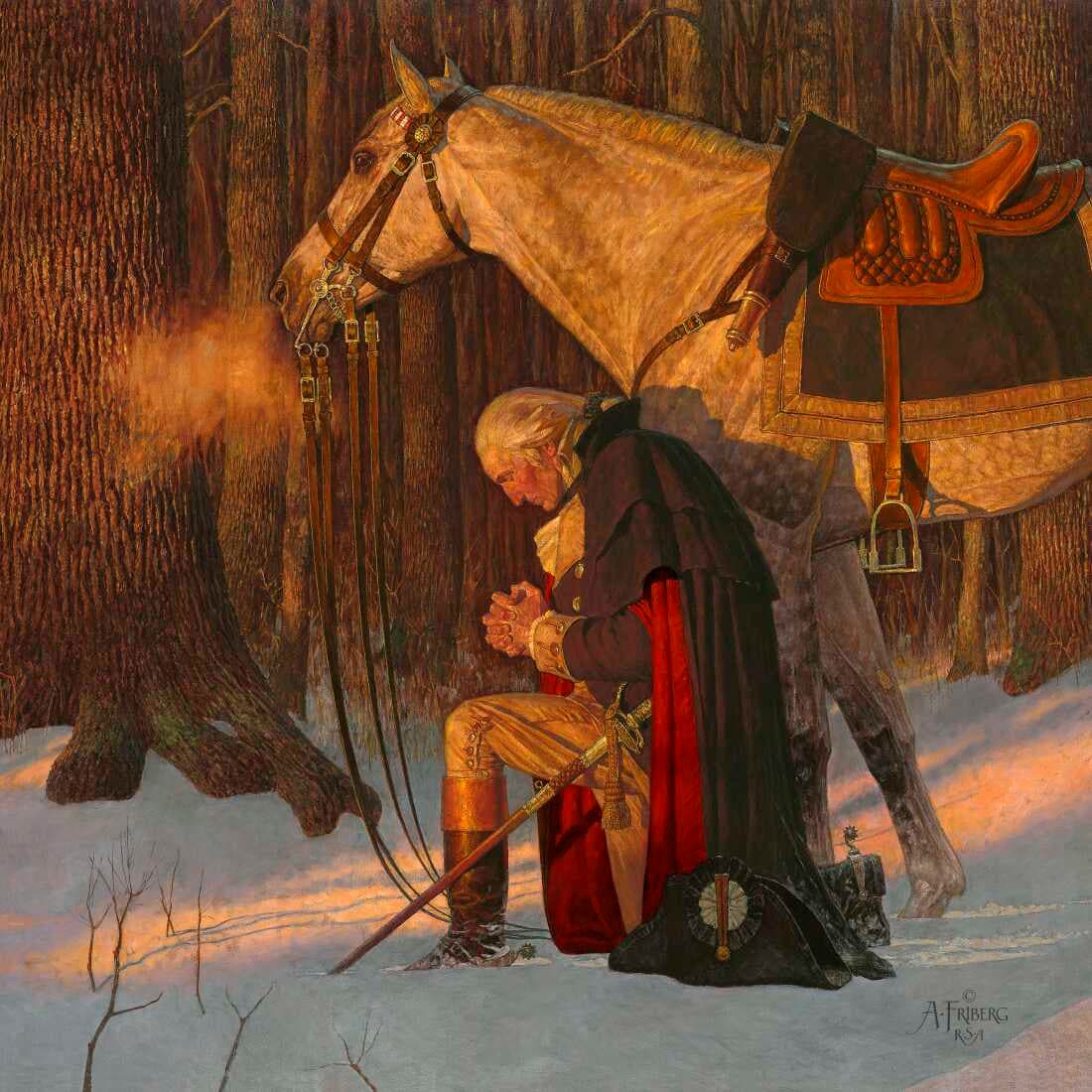
A certain Mr. Isaac Potts was a resident near Valley Forge. He was a Quaker and opposed to the war. As recorded in The Diary and Remembrances of Rev. Nathaniel Randolph, we have a record of Mr. Potts’ testimony, which is as follows:
“I was a rank Tory once, for I never believed that America could proceed against Great Britain whose fleets and armies covered the land and ocean. But something very extraordinary converted me to the good faith.
“I saw the great George Washington on his knees alone. . . . He was at Prayer to the God of the Armies, beseeching to interpose with his Divine aid, as it was . . . the cause of the country, of humanity, and of the world.
“Such a prayer I never heard from the lips of man. . . . [I] never thought a man could be a soldier and a Christian, but if there is one in the world, it is Washington. [I] thought it was the cause of God, and America could prevail.”
America did prevail as a nation under God. Our Founding Fathers repeatedly acknowledged God’s hand in bringing about America’s independence and her Constitutional framework, which depends upon virtuous living and self-government. As Dr. Franklin declared in the midst of the debates of the Constitutional Convention, “God governs in the affairs of men. And if a sparrow cannot fall to the ground without his notice, is it probable that an empire can rise without his aid?”
For the creation of a more perfect union, our Founding Fathers pledged their all and relied upon God to make up the difference. Under the simple title of “A Declaration,” fifty-five men pledged their lives, their fortunes, and their sacred honor, and they did so “with a firm reliance on the protection of divine Providence.”
They declared, “We hold these truths to be self-evident: That all men are created equal: that they are endowed by their Creator with certain unalienable rights: that among these are life, liberty, and the pursuit of happiness.”
The Founders did not stumble upon the brilliance of the Declaration of 1776. They were well-versed in the writings of classical authors, and their minds were well-trained in principled ideas that had been discussed and debated for centuries. The American system of government was built upon the American ideals enshrined in the Declaration of Independence by men whom God raised up for that very purpose.
In his book entitled The Pursuit of Happiness: How Classical Writers on Virtue Inspired the Lives of the Founders and Defined America, Jeffrey Rosen wrote of the Founders’ classical understanding of what it meant for one to engage in the “pursuit of happiness.”
“Today we think of happiness as the pursuit of pleasure. But classical and Enlightenment thinkers defined happiness as the pursuit of virtue— being good rather than feeling good.
“For the Founders, happiness required the daily cultivation of virtue, which the Scottish philosopher Adam Smith defined as the temper of mind which constitutes the excellent and praiseworthy character.
“If you had to sum it up in one sentence, the classical definition of the pursuit of happiness meant being a lifelong learner with a commitment to practicing the daily habits that lead to character improvement, self-mastery, flourishing and growth. Understood in these terms, happiness is always something to be pursued rather than obtained, a quest rather than a destination.”
In other words, the American pursuit of happiness is the pursuit of virtuous living. It is the daily endeavor to love that which is good so that we can become our best selves and serve others. This vision of virtuous living is uniquely aligned with Latter-day Saint doctrine.
As members of the Church of Jesus Christ of Latter-day Saints, we enjoy the knowledge of precious truths restored to the earth by prophets and apostles acting with authority given from God. We know the purpose of our life on earth as declared in our Heavenly Father’s divine mission statement: our God declared, “For behold, this is my work and my glory—to bring to pass the immortality and eternal life of man” (Moses 1:39).
Christ’s divine mission is in complete unity with the Father, and He was sent by the Father to enable us to reach such divine heights. By divinely inspired doctrine, we understand that the high purpose of man’s existence is to become like God, to become as He is and live as He does. All other interests and activities which may occupy our earthly time are secondary to those divine objectives which are the work and glory of God.
In a very literal sense, Latter-day Saints understand that the purpose of our mortal life on earth is to learn God’s way of life. We believe in education for exaltation. This world was divinely prepared by the Creator for that very purpose.
God is the freest of all beings. It is through our Savior Jesus Christ that we are enabled to attain godly freedom and to become just as God is and live just as God does. God is omnipotent because He knows all laws and is perfectly obedient to them; that is a defining characteristic of a god. There are many who may, in error, think that freedom means the freedom to do anything one wishes, but true freedom comes from discipline and obedience: in other words, using our moral agency wisely and in the ways God would smile upon.
It takes discipline and obedience to attain freedom and to preserve freedom, both at church and in the public square. This principle is one reflected in many of the Founders’ writings. George Washington wrote in his First Inaugural Address of the “indissoluble union between virtue and happiness.” The way to create a more perfect union was for citizens to be self-governed in both public and private by adhering to “the eternal rules of order and right, which Heaven itself has ordained.”
In his Farewell Address, Washington wrote, “Of all the dispositions and habits which lead to political prosperity, religion and morality are indispensable supports. In vain would that man claim the tribute of patriotism who should labor to subvert these great pillars of human happiness.”
Whereas the laws of the land permitted the Americans to do as they pleased, religion and the moral teachings which it imprinted upon the minds and hearts of citizens prevented the Americans from daring to think and do anything that was otherwise legally permissible. America is a nation undergirded by faith, built by faith, and enlivened by faith. Our unique religious culture is foundational to America’s greatness. Faith and freedom are inseparable.
Upon his arrival in the States, Frenchman Alexis de Tocqueville found himself fascinated by the intimate union of religion and politics that he observed reigning over the whole American nation. He traced this marvelous combination back to the Puritan colonies in New England and designated this peculiar union of religion and politics as the Puritan “point of departure,” the point to which the whole character of America and the whole destiny of the land could be traced.
Whereas politics and religion had always been opposed in Europe and particularly in his home country of France, Tocqueville found that these two seemingly opposing forces were intimately united and had not ceased to be so from the time of their first uniting long before the nation had been established.
However, this is an American ideal that many today have forgotten. Our religious heritage and culture are under attack. What began as so-called religious neutrality has become religious hostility. There are many who seek to erase the influence of God in our nation from our history and from our public life. Many would have us convert from a nation under God to a nation without God.
Today, as never before, our country needs men and women who possess the moral strength of our forefathers and recognize the dangers of comfortable complacency. Let us pray for the strength to stand for freedom and to stand for the laws of our Eternal God, no matter the cost.
We may think we stand alone; there may be many who oppose us. But as Ethan Allen, John Adams, and Isaac Potts each witnessed and testified, when we stand for freedom, we stand with God. We are not and never will be alone.
In response to the question of how we can best honor and remember the sacrifices that many great Americans have given in offering their lives for the protection of this nation and her citizens, someone once said, “Be the American worth fighting for.”
As we celebrate the American patriots who sacrificed so much for their God, their families, and their country, let us reflect on what more we can do to contribute to their legacy in how we respond to the challenges facing us in this day and age.
With Captain Moroni, let us raise our own title of liberty “In memory of our God, our religion, and freedom, and our peace, our wives, and our children,” and let us pray unto God for the blessings of liberty to rest upon this nation, “so long as there should a band of Christians remain to possess the land” (Alma 46:12-13).
For the many who died to make men free, let us live to make men free. Let us each pursue happiness by pursuing virtue and encourage our fellow men to do the same. It is in our homes, our churches, and throughout our daily lives that we exemplify what it means to be an American, what it means to pursue happiness grounded in godly virtue.
The beauty of America is in our motto: In God We Trust. May we ever continue to put our trust in God.