
When my article addressing Charlie Bird’s plans to obtain a child through egg donation and surrogacy was published last week, I was prepared for some blowback. I also knew there was no way I could address every problem with the fertility industry and same-sex parenting in one op-ed.
I was surprised, however, at how many people conflate surrogacy and egg and sperm donation with adoption. Comment after comment claimed that the arguments I made against Charlie Bird’s decision to pursue fertility practices that deprive children of at least one biological parent could also be applied to adoption. So let’s talk about it. Allow me to explain how — in actuality — the gift of adoption illuminates the many ethical problems with the fertility industry and the actions of people like Charlie Bird.
Surrogacy vs. Adoption
On the surface, adoption and surrogacy share some similarities. Both result in a child being separated from at least one biological parent. In both circumstances, children may experience some adverse effects as a result of separation from their birth mothers, though the current scientific literature is not currently able to clearly isolate the effects of this separation from other potentially relevant factors. On a philosophical level, children’s right to being raised by loving biological parents is infringed upon in both scenarios. This is where the similarities end.
As has been pointed out by countless internet commenters, we live in a world in which tragedies happen, in which families frequently fall short of the Lord’s ideal. Sometimes children lose their parents through death. Other times, biological parents are unfit to care for their children because of severe mental illness or substance abuse. Perhaps most tragically, biological parents sometimes abuse and mistreat their children. I imagine there is no shortage of millstones to go around for that special breed of evil.
Adoption is society’s best effort to remedy the wound of parent loss in all of these circumstances, and it is a practice older than recorded history. Moses, a great prophet who faced more difficulty than most, is an example of an adoptee who achieved both greatness and goodness in spite of less-than-ideal family circumstances. Many of my own family members are adopted, and one of the most important mentors in my life is an adoptive father of two precious girls.

Surrogacy, egg donation, and sperm donation, on the other hand, cause the very same harm that adoption attempts to heal. In these scenarios, parent loss is intentionally brought about by the adults in a child’s life.
These fertility practices are problematic enough when pursued by a heterosexual couple, in which case the child will at least have a social mother and father. I would argue that it is worse when pursued by a homosexual couple. This is not because same-sex couples are incapable of love, nurturing, and caring for a child, but rather because children need the influence of a man and a woman for healthy development.
Social science supports the idea that men and women parent differently. We cannot fill each other’s shoes.
It is also worth pointing out that the technologies in question here are so new that they are essentially still a social experiment. Never before in human history have same-sex relationships been elevated to the status of marriage. Never before have we been able to use artificial insemination to create children that will not be raised by the women who birthed them — or any women.
The Dangers of Unrelated Adults
The seriousness with which we treat adoption as a society is another clue into the irresponsibility of the fertility industry. Statistically, the most dangerous person in a child’s life is an unrelated adult living in the home. Adoption agencies must therefore be incredibly diligent to make sure intended parents are safe adults for the child they intend to bring into their lives.
I hope we can all agree that no couple is entitled to adopt someone else’s child. Adoption is only permitted when it is in the child’s best interest. Why, then, do we behave as if any couple – gay or straight – is entitled to procure a child through fertility treatments when at least one member of the couple will not be biologically related to the child at all?
Disturbingly, intended parents who use surrogacy and egg and sperm donation to have a child are not legally required to go through the rigorous process of background checks and approval to which adoptive parents are subject. Some fertility clinics do require background checks of intended parents, but they are not mandated by law at the federal level. More often, fertility clinics require background checks of the gestational surrogate whose body is being rented. This kind of negligence results in horror stories like this one.
I can practically hear the outcry: “Are you preemptively accusing Charlie and Ryan of abusing their future child?!” No, certainly not. They seem to be two decent people who want to care for a baby, become fathers, and experience the kind of family life they have dreamed of throughout their lives. I have sympathy for that. But their wants do not come before a child’s rights and needs, no matter how deep and sincere those wants are. Additionally, normalizing nontraditional family structures paves the way for would-be abusers.
We take adoption seriously because the biological relationship between parents and children matters. We should take surrogacy, same-sex parenting, and egg and sperm donation just as seriously.
Surrogacy Contracts: People as Commodities (Again)
Some critics of my last article dismissed the idea that women are commoditized and objectified by surrogacy by claiming that consent on the part of the woman is sufficient to render the arrangement morally acceptable. I disagree with that claim. I would argue that people can consent to being objectified, that they can even objectify themselves, and that objectification is still wrong in every instance. One need only look at the average OnlyFans “model” to come to that conclusion.
If you need further convincing, though, it might be helpful to understand a little bit about what the typical gestational surrogate agreement includes.
The enforceability of surrogacy contracts varies from state to state. In the state of Utah, surrogacy contracts are enforceable, meaning a gestational surrogate can be held legally liable for breaching the agreement. Breaches of the agreement might include refusing prenatal testing (which might lead to abortion), refusing pregnancy reduction (which is abortion), or refusing to terminate the pregnancy (also abortion). Agreements also often stipulate what a gestational surrogate can eat and when she can travel. All of this is concerning when we consider that most surrogate mothers are of a lower socioeconomic status than the intended parents who hire them. This actually creates a similar incentive structure to the one that exists in the euphemistically named “sex work” industry.
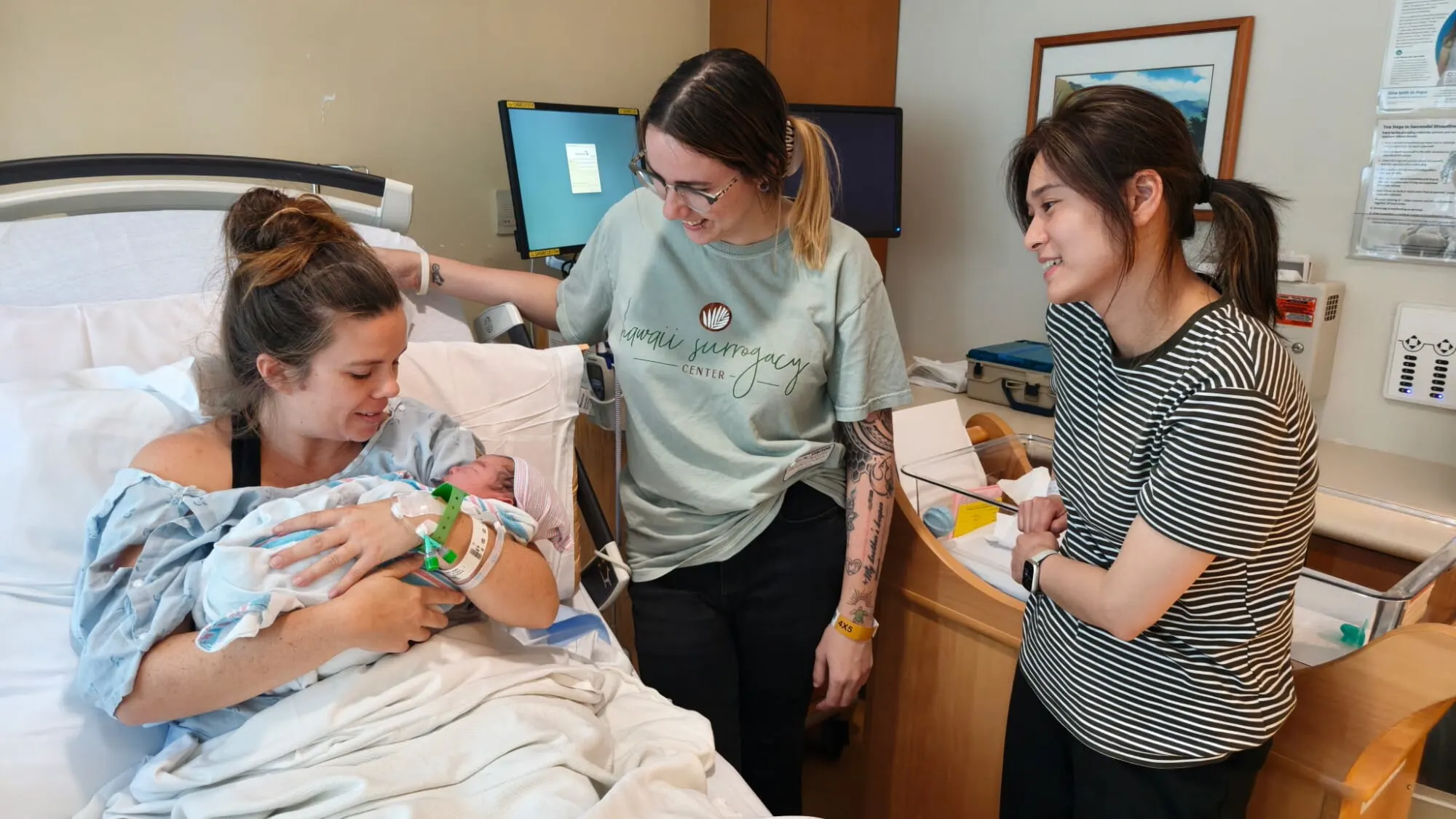
A surrogate mother at the Hawaii surrogacy center. (hawaiisurrogacy.com)
Louise Perry, author of The Case Against the Sexual Revolution and host of the Maiden, Mother, Matriarch podcast, has made the point that women who may not otherwise pursue sex work are more likely to consider it when it is legal, socially normalized, and perceived to be profitable. I would argue the same principle applies to would-be gestational surrogates. This is not to say that gestational surrogates have no other, altruistic motives for carrying other people’s children. I believe they do. But it only takes a cursory Google search to find countless stories of women who have been victimized in the course of carrying out their obligations as gestational surrogates.
Surrogacy agreements also dehumanize unborn children. Consider the following dystopian line from a standard gestational carrier agreement template: “The intention of this Agreement is to allow Intended Parents to decide whether to terminate a pregnancy with their Child if the Child has medical conditions that Intended Parents find incompatible with an acceptable quality of life…” If you do not see the problem with killing an unborn baby based on a subjective determination about his or her future quality of life, then I doubt you will find anything in this article convincing.
Why Charlie Bird?
Some of you may be wondering why in the course of discussing moral concerns with the fertility industry generally I chose to call out Charlie Bird by name. In answer to the question, he was actually the catalyst for this series. While I have been passionate about the pro-life cause, fertility ethics, and the preservation of the traditional family for years at this point, I felt compelled to address these issues more publicly after following Charlie Bird and consuming his content.
Let me say that he seems to be a genuine, affable guy. I have no personal animus towards him or his husband, but I think the net influence of their platform on the culture of the Church is negative.
It does not seem in line with our collective mission of gathering Israel to normalize abandoning temple covenants and living outside the bounds of God’s law for sexual relationships. I wholeheartedly believe that the Church is and should be a place for all people, regardless of identity, specific sins, and sexual proclivities. But as has been taught time and time again, Jesus Christ meets us where we are and always invites us to go higher.
"The Sermon on the Mount", by Harry Anderson
In response to the critique that my last article (and probably this one) is a personal attack, I can only say that I believe it is perfectly acceptable to not only have an opinion, but also to discuss that opinion openly, on the personal choices of a public figure whose platform is built upon personal choices.
If I could talk to Charlie Bird personally, I would. Unfortunately, he has blocked me. From what I understand about his interactions with other critics and influencers, he does not seem open to conversation.
A Gospel Perspective
The Church General Handbook section on surrogacy says, “The pattern of a husband and wife providing bodies for God’s spirit children is divinely appointed. For this reason, the Church discourages surrogate motherhood.” By contrast, the Handbook supports married couples who wish to adopt children and even directs them to resources they can use to embark on that journey.
We also learn that children born of surrogate mothers are not automatically born into the covenant and must be sealed to their parents. This should at least give us pause as we rush to champion practices and relationships that cannot, by their very nature, lead to covenant making and keeping. If we truly believe in the doctrines that make The Church of Jesus Christ of Latter-day Saints unique, we must hold the line on the family.
To return to a theme from my previous article, I want to look more closely into the importance of motherhood in a child’s development. Fathers are also deeply necessary, but since the lightning rod in this conversation has to do with two married men, I will limit myself to discussing motherhood.
Jenet Erickson, a social scientist and BYU religion professor has said, “A mother is primed to establish a bond through which the emotional communication that is essential for a child’s development can occur. Her infant is also primed to bond with her, already knowing her smell, her voice, and her face. This remarkable relationship appears to shape foundations of identity, sense of well-being, and emotional understanding.”
I think this scientific reality is undergirded by an eternal pattern. We uniquely believe in a Mother in Heaven. We believe that complete divinity is composed of perfected manhood and womanhood. If we give this up, we give up so much that is true and beautiful.